
Key takeaways
- A client-facing audit needs one structure every time: executive summary, then a prioritised issue list, then fix steps, then a note on what happens next
- Sort by real impact, not by severity label alone, or you hand a client forty "high" issues with no way to tell which one is actually costing them traffic
- Leave the raw crawl data out of the meeting; it belongs in an appendix or a CSV, not the slide a client is reading
- Proving a fix worked means re-crawling and comparing, not asking the client to take your word for it
A technical SEO audit and a client-facing presentation of that audit are two different documents, and treating them as the same thing is the most common way a genuinely good piece of analysis fails to land. The audit itself can, and often should, run to hundreds of findings across dozens of pages. What a client needs in the room is something else entirely: a short, ordered list of what matters, in language that doesn't require them to know what a canonical tag is, with proof at the end that whatever gets promised actually happened.
This is a structure for that second document, built around four questions a client actually has: what's wrong, what matters most, what do we do about it, and how will we know it worked.
Start with the outcome, not the audit
Before any findings, a client-facing audit needs a short executive summary that answers the question a client is actually asking, which is rarely "what technical issues exist on my site". It's closer to "is my site working for me, and if not, what's the plan". Two or three sentences: the overall picture, the one or two things worth caring about most, and what happens next. Everything below the summary is evidence for a case the summary has already made.
Skip the framing that talks about the audit process itself, how many pages were crawled, which tool did the crawling, how the scoring works. That's context for you, not news for the client. Lead with what changes for their business.
Structure the findings as a prioritised list, not a raw dump
A thorough crawl of a real site routinely produces hundreds of findings. Handing that list over unfiltered, even sorted by severity, isn't a report; it's the raw material a report should have been built from. Severity alone sorts a 500-visit-a-month blog post's broken heading structure next to the homepage's, as if they were the same problem.
The fix is to prioritise by actual reach before anything else. Crawl Cove's impact score does this by weighting each finding against the real Google Search Console impressions the page it's on already earns, so a "fix these nine first" list comes out the other end of a few hundred raw findings, rather than a wall of severity labels a client has no way to rank against each other. Whatever tool produces the list, the principle holds regardless: traffic-weighted priority beats a flat severity sort, because it answers "which of these is actually costing me something" instead of just "how bad is this in isolation".
Ten issues is a workable ceiling for a client-facing list on most sites. Fewer than that on a genuinely clean site is fine, and worth saying plainly rather than padding the list to look thorough. More than that, and you're back to the wall of findings the prioritisation step was meant to avoid.
Write each issue for the person reading it, not the person who found it
Every issue on the client-facing list needs three things: what's wrong, in plain language; why it matters to their business specifically, not to SEO in the abstract; and what fixing it involves. "Missing meta description on 40 product pages" is a fact. "40 of your product pages are showing Google's own auto-generated snippet in search results instead of the sales copy your team wrote, which is worth writing back in" is the same fact, aimed at someone deciding whether to prioritise the fix.
Drop the raw evidence from the summary itself: the exact HTML snippet, the full URL list, the check ID. That detail is essential, but it belongs one level down, in an appendix, a linked spreadsheet, or handed directly to whoever implements the fix. Crawl Cove's evidence drawer keeps that detail attached to each finding, so a developer or CMS-side implementer can open the same audit and get the offending HTML, an effort estimate and a route to a tracked task, without it ever needing to appear on the client-facing page.
Leave the raw crawl data out of the room entirely
A full crawl export, hundreds of rows of status codes and URLs, is a genuinely useful artefact and a genuinely bad thing to open on a screen in front of a client. It answers the wrong question at the wrong time: a client in a review meeting wants to know what's being fixed and why, not to watch you filter a spreadsheet live. Keep the full export as a downloadable appendix to the report, referenced but not walked through, for whichever technical stakeholder on the client's side actually needs it.
The same goes for methodology detail that exists to make the audit defensible to another SEO, not to inform the client's decision. (What the audit costs, and how the deliverables in the meeting map to that price, is a separate conversation: see how much to charge for an SEO audit.) A dated note on how competitor prices or figures were checked belongs in the document; a paragraph explaining crawl depth settings usually doesn't.
Prove the fix worked, don't just say it did
The part of an audit relationship that erodes trust fastest is the gap between "we fixed that" in a status update and any actual evidence the fix landed. A client who has been told three months running that "the technical issues are being addressed" with nothing to show for it stops believing the sentence, reasonably.
The fix is to re-crawl after the work ships and compare the new run against the one before it. Crawl Cove's versioned audit runs do this automatically: every crawl is timestamped and compared to the one before it, so each finding carries a delta chip showing whether it's new, fixed, or still open. A "fixed" chip means that exact issue, on that exact URL, was checked again and is genuinely gone, not a status someone typed into a report. Over several months, that history becomes the retainer's own case for itself: a client can see the count of open issues fall run over run, which is a considerably stronger argument for continuing the work than a fresh page of new complaints every month.
Package it once the structure is right
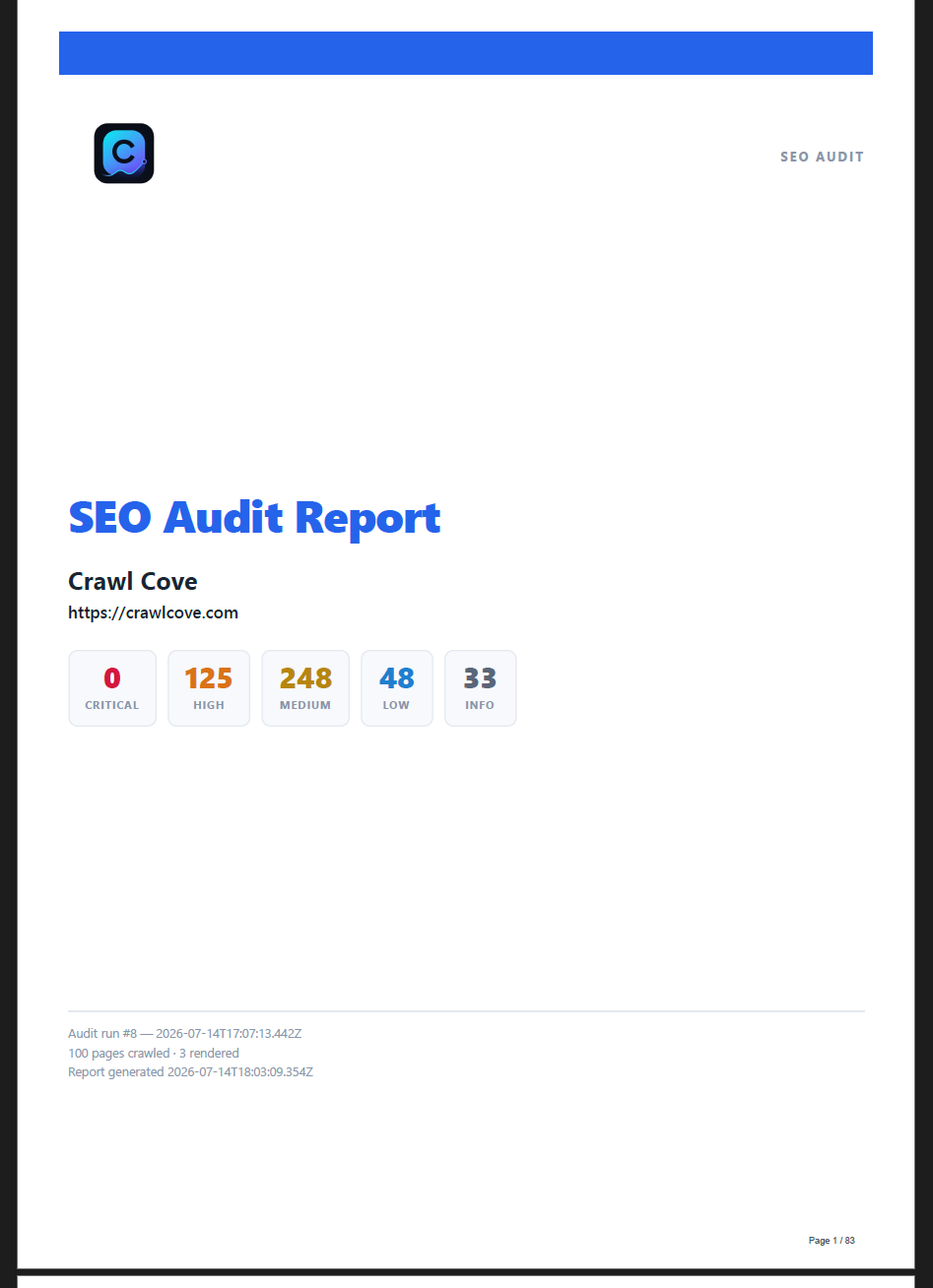
Once the summary, prioritised list and proof-of-fix sections exist, the packaging is the easy part. A branded PDF with the client's own logo and colours, generated straight from the same audit data rather than rebuilt by hand each time, keeps the report consistent from month to month and saves the hour or two most agencies spend on copy-paste before every client meeting.
Wrap-up
A client-facing SEO audit is a different document from the audit itself: an outcome-led summary, a list prioritised by real impact rather than severity alone, plain-language issues with the raw evidence pushed to an appendix, and proof, not a promise, that each fix actually landed. Build the structure once and the rest of the report, the branding, the delivery, the month-to-month cadence, follows from it.
Frequently asked questions
- Do I need to show every finding in the client meeting?
- No. A full crawl of a real site routinely turns up hundreds of findings, and walking through all of them buries the handful that matter under noise nobody in the room can act on. Present the prioritised top issues, and keep the full list available as a CSV or PDF appendix for whoever on the client's side actually implements fixes.
- How many issues should a client-facing summary include?
- Enough to fill one focused conversation, not the whole audit. Ten is a workable number for most sites: specific enough to feel actionable, short enough that a client can hold all of it in their head by the end of the call.
- How do I prove a fix actually worked, not just that I said I fixed it?
- Re-crawl the site after the fix ships and compare the new run to the one before it. A tool that keeps versioned audit history can show the exact finding gone in the new run, on the exact URL, which is a materially stronger claim than a bullet point saying "fixed" in a status update.
- What if the audit turns up very few issues, or the client's site is already in decent shape?
- Say so plainly. A short, honest "here's what's already working, and here are the three things worth doing next" builds more trust than padding a report to look thorough. A prioritised list scales down to a handful of items just as well as it scales up to fifty.