
What is AI search visibility?
AI search visibility, also called generative engine optimisation (GEO), is the practice of making your content easy for AI systems to understand, extract and cite. Where traditional SEO asks "will this page rank in a list of ten blue links?", GEO asks a slightly different question: "will this page get pulled into the answer itself?"
That answer might appear in:
- ChatGPT or Perplexity, when a user asks a question your content covers.
- Google AI Overviews, the summarised answer that now sits above traditional results for many queries.
- Other AI-powered answer engines that summarise, quote or link back to source pages.
GEO is a young discipline, and how each of these systems selects and weights sources isn't fully public or fixed. It keeps changing. Treat anything you read on it, including this page, as directional rather than a guaranteed recipe.
AI search visibility builds on technical SEO
The good news is that AI search visibility doesn't replace the fundamentals. It depends on them. A page has to clear the same basic bar it always has before an AI system can consider it, let alone cite it:
- It must be crawlable: not blocked by robots.txt, not orphaned, not stuck behind JavaScript a bot can't render.
- It must return a clean response: a real 200, not a soft 404 or an error page dressed up as content.
- It must have a clear, logical structure: headings that describe what follows, not decorative styling.
- It should carry valid structured data where relevant, so machines don't have to guess what an entity, product or article actually is.
If you haven't already covered this ground, our technical SEO guide is the right starting point. A structured data checker and a general SEO audit do double duty here, because the same crawlability and markup work that helps traditional search also underpins GEO.
The signals that help AI engines understand your content
Once the technical basics are sound, a handful of content-level signals seem to make pages easier for AI systems to parse, extract and quote:
- Clean heading hierarchy. A logical H1 → H2 → H3 structure lets a model map out what a page covers without reading every word.
- Question-and-answer patterns. Content that states a question plainly and answers it in the next sentence or two is far easier to lift into a generated answer than a paragraph the reader has to interpret.
- Extractable lists and tables. Steps, comparisons and criteria formatted as lists rather than buried in prose are simpler for a model to summarise accurately.
- Schema.org markup. Article, FAQ, Product and Organization schema (among others) give machines explicit, structured facts instead of forcing them to infer meaning from layout.
- An llms.txt file, covered below.
- Not blocking the crawlers you want. It's easy to lock down
robots.txtagainst "bots" in general and inadvertently shut out an AI crawler you'd actually like indexing you. Review your rules with a robots.txt generator rather than guessing.
None of this guarantees a citation. It removes friction that would otherwise stop a well-suited page from ever being considered.
Tip
Pick five real questions your customers ask and check whether any single page on your site answers each one in a self-contained paragraph, in plain language, near the top of the page. If the honest answer is scattered across three pages or buried after 800 words of preamble, that's the content gap GEO work should close first.
What is an llms.txt file?
llms.txt is an emerging, unofficial standard, modelled on robots.txt, that points AI crawlers to your most important content in a clean, easily parsed form. It's typically a plain Markdown file at your site root listing key pages with short descriptions, so a model can quickly find your best material instead of trying to reconstruct your site structure from a crawl.
Adoption isn't universal, and it's not confirmed that every AI system reads or prioritises it. It's a low-cost, sensible addition rather than a silver bullet: worth having, not worth over-investing in at the expense of the content itself.
Which AI crawlers Crawl Cove checks for
Blocking a crawler is sometimes deliberate, and sometimes a Disallow: * written for a different reason catches a bot you'd rather have reading you. Crawl Cove checks your robots.txt for exactly four answer-engine tokens, taking bot-specific rule groups into account rather than just the wildcard group:
| Token | Operator | Purpose | If you block it |
|---|---|---|---|
GPTBot |
OpenAI | Model training | Excluded from future training; ChatGPT's live browsing and search are unaffected |
ClaudeBot |
Anthropic | Crawls for Claude | Your content can't be referenced in Claude's answers |
PerplexityBot |
Perplexity | Crawls for Perplexity's answer engine | Your content can't be cited in Perplexity answers |
Google-Extended |
Training opt-out for Gemini / Vertex AI | No effect on Googlebot, Google Search or AI Overviews, which are unaffected by this token |
This table was checked in August 2026 against each operator's own documentation. Operators add and retire tokens, so treat it as a snapshot rather than a permanent list.
How to check your AI search visibility
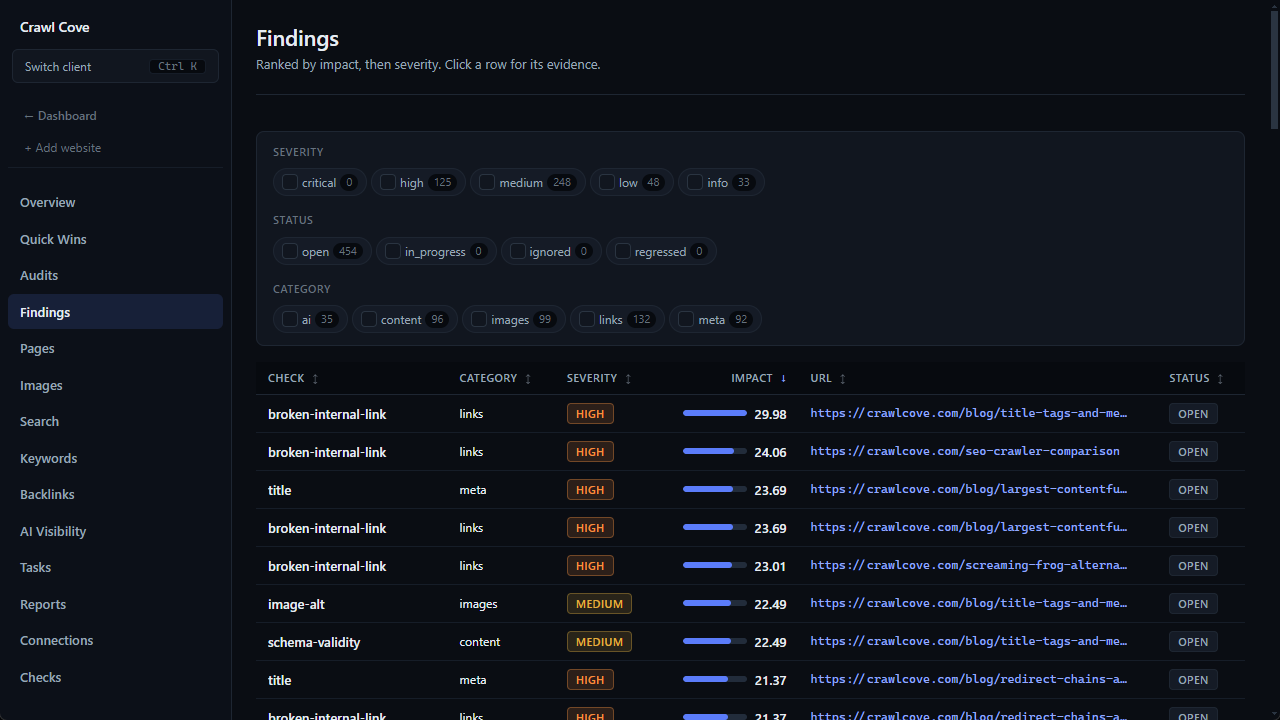
Most of this is auditable the same way you'd audit any other technical or content issue: systematically, across the whole site, rather than page by page from memory. Crawl Cove checks the signals above in a single desktop crawl: whether an llms.txt file exists at your site root, whether pages are structured for extraction (clear headings, direct answers, usable lists), where Schema.org markup is missing or invalid, which pages are unintentionally blocked from the four AI crawlers above, whether your site exposes Organization or Person entity markup with the sameAs links engines use to identify who runs it, whether article pages name an identifiable author, and whether article pages carry a dateModified freshness signal. It's a paid desktop app for Windows and macOS with no URL cap, so with Max pages raised from its shipped default of 500 it audits your whole site rather than a sample, and results come back as plain-English, prioritised fixes rather than a raw data dump. Crawls run locally, so nothing about your content or structure is uploaded to us.
One honest limit worth stating plainly: Crawl Cove audits the structural and technical groundwork that makes a page citable. It does not track whether or how often your pages actually appear inside ChatGPT, Perplexity or AI Overviews once you've published. That's a separate, evolving measurement problem GEO tooling as a category hasn't settled yet.
Fix the structural gaps first, since they're the ones you fully control, then see the features and pricing pages for what's included in a Crawl Cove audit.