
Most SEO tools hand a client a fresh report every month and quietly hope nobody compares them. Crawl Cove is built the other way around. Every audit is a timestamped, versioned run, and each run is automatically compared to the one before it — so instead of "here are this month's issues," you can say "here's exactly what we fixed, and here's the proof." That's the difference between sending a PDF and defending a retainer.
Every run is a version
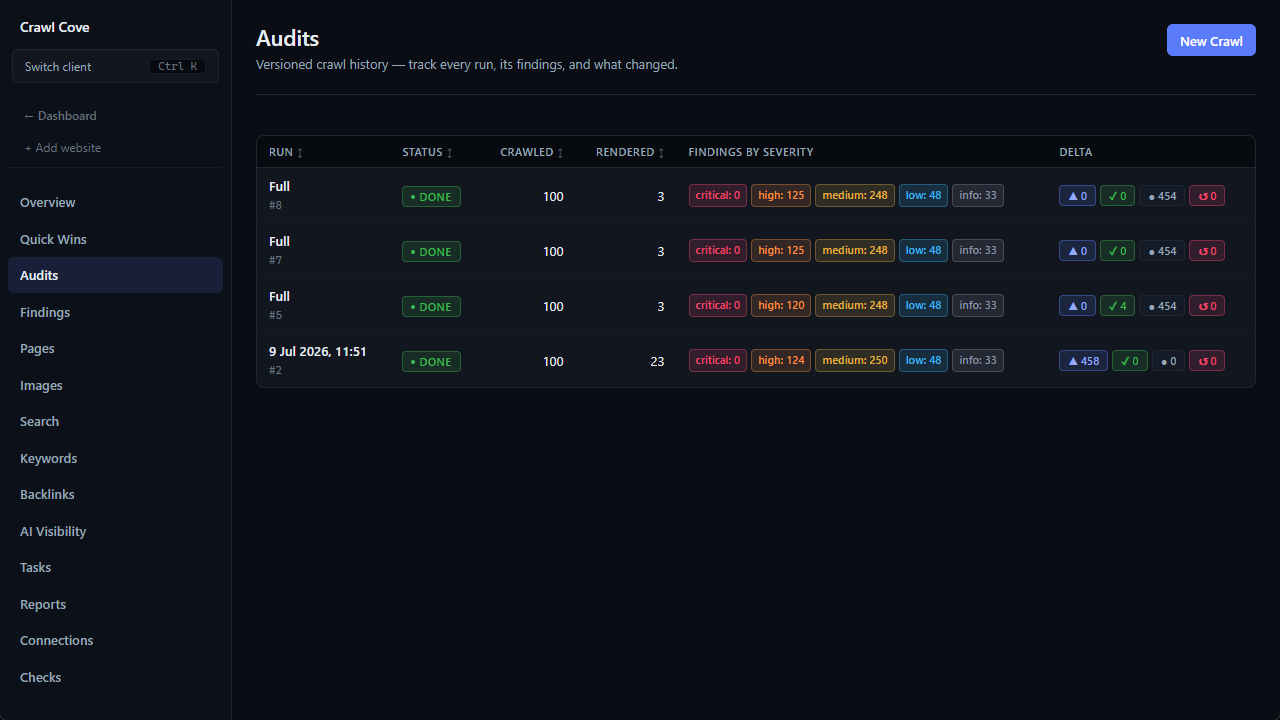
Audits live on the client's Audits (Crawl Runs) page. Each run row records its status, the pages crawled and rendered, and the findings broken out by severity. The history accumulates — runs are never overwritten — so the page becomes a longitudinal record of the site's health, not a snapshot you have to re-create from memory.
Delta chips: new, fixed, persisting
From the second run onward, each row carries delta chips comparing it to the previous run:
- ▲ new — findings that appeared since last time.
- ✓ fixed — findings that were present before and are now gone.
- ● persisting — findings still open from the last run.
Because findings are keyed by (check id, URL) and every check is version-pinned, these deltas are honest. A "fixed" chip means that exact issue on that exact URL is genuinely gone the next time the crawler looked — not an AI's opinion, not a number that quietly changed because the tool updated a rule under you.
Why this wins retainers
A one-off audit is a sales document. A versioned audit history is a relationship. When a client asks the inevitable question — "what am I actually paying you for?" — you don't reach for adjectives. You open the Audits page and point at the ✓ fixed chips climbing month over month, with the severity counts falling alongside them.
This is also the engine behind the self-verifying Tasks board: when the next crawl confirms a finding is gone, the linked task moves itself to Verified Fixed; if it came back, it bounces to Regressed. The proof and the project tracking are the same source of truth.
Tip
Tie the runs to the retainer rhythm: monthly crawl → findings review → report → call. Schedule the crawl to land a few days before your check-in, walk the client through the delta chips on the call, and let the white-label report carry the same story home. The numbers do the persuading; you just narrate.
A note on impact
Delta chips tell you what changed. Pair them with impact score (which needs Google Search Console) and you also know whether it mattered — fixing nine findings on pages worth tens of thousands of monthly impressions is a very different story than fixing nine on pages nobody visits. See Prioritising with impact score.
Next steps
- Mastering the Findings Explorer — work the issues behind the chips.
- White-label reports — carry the prove-the-fix story into a branded PDF.