
Key takeaways
- "Discovered - currently not indexed" means Google found the URL but has not crawled it yet, usually because it deprioritised the crawl rather than hit an error
- It is not a penalty and does not mean anything is wrong with the page; Google's own guidance is that no action is needed in most cases
- Requesting indexing or fixing internal links can help, but nothing forces Google to crawl and index a URL on a schedule you control
- We pulled our own live index status for pages across crawlcove.com while writing this, and several were sitting in exactly this state
"Discovered - currently not indexed" is one of the most common lines in the Page indexing report, and one of the most misread. It sounds like a rejection. It usually isn't. This is what the status actually means, why Google's own documentation says most of the time there is nothing to fix, and what real examples from our own site look like while we were still working through this exact problem.
What "Discovered - currently not indexed" actually means
Google's own definition, from its Search Console Help documentation, is specific:
"The page was found by Google, but not crawled yet. Typically, Google wanted to crawl the URL but this was expected to overload the site; therefore Google rescheduled the crawl."
Read that carefully: the page has been found, usually through a sitemap, an internal link, or an external link, but Google has not actually fetched it yet. Nothing about the page's content, quality or relevance has been judged, because Google has not looked at it. This is a scheduling state, not a verdict.
Google's guidance for this exact status is refreshingly plain: no action is needed in most cases. The page will be crawled when Google decides it's appropriate to spend the crawl budget on it.
Note
This is different from "Crawled - currently not indexed", where Google did fetch the page and chose not to index it. That status is usually a content or duplication judgement. "Discovered" means Google hasn't looked yet at all. See the FAQ below for how the fixes differ, or read the full Crawled - currently not indexed explainer.
Real examples, checked this session
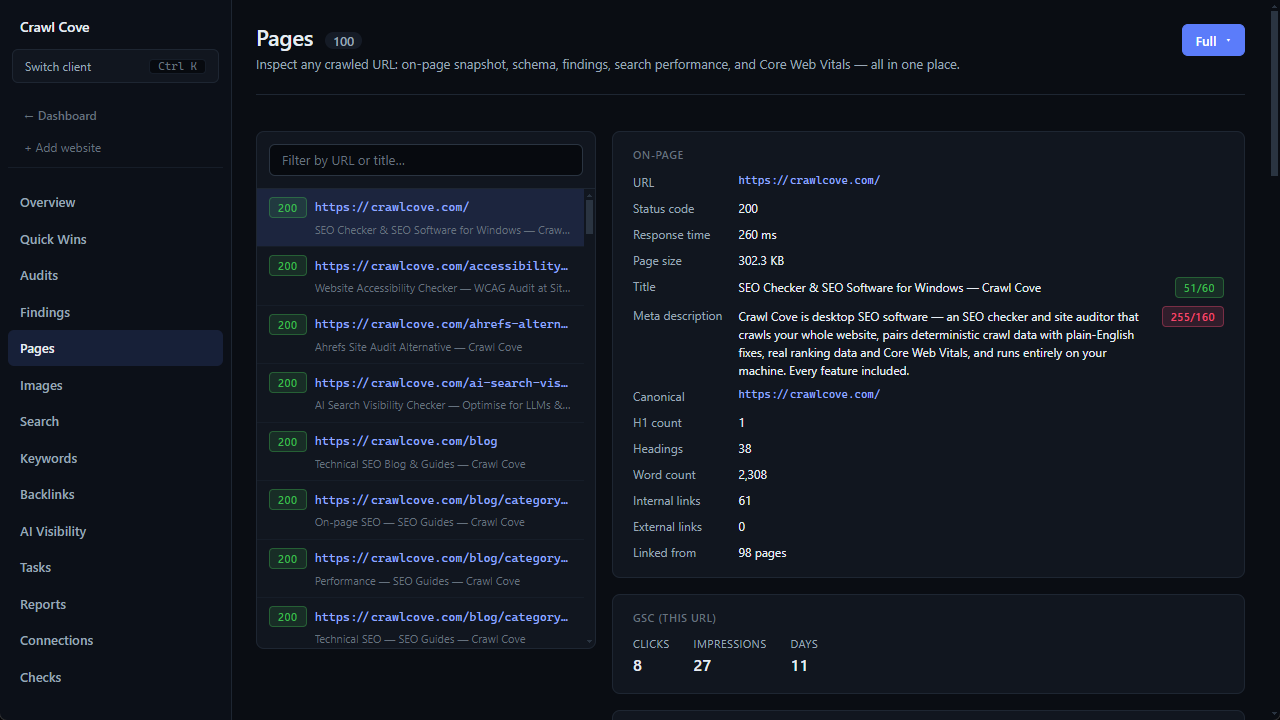
Rather than describe this in the abstract, here is what our own URL Inspection turned up on crawlcove.com when we checked, on 20 September 2026:
/xml-sitemap-checker: Discovered - currently not indexed/screaming-frog-vs-lil-robots: Discovered - currently not indexed/guides/multiple-websites-per-client: Discovered - currently not indexed/blog/free-seo-crawlers-reviewed: Discovered - currently not indexed
All four are live, linked from elsewhere on the site, and carry no noindex directive. Nothing is broken about them. They are simply queued: found, not yet fetched. Meanwhile, dozens of other pages published in the same window (checked in the same batch) already show "Submitted and indexed", so this is not a site-wide block. It is Google working through a crawl queue at its own pace on a site that is still relatively new and still earning crawl trust, exactly the pattern the status describes.
Why this happens
A handful of factors decide how quickly Google works through its discovered-but-uncrawled queue:
- Crawl budget. Google allocates crawl activity per site based on its assessment of the site's overall authority and the server's capacity to handle requests. A newer or smaller site gets a smaller, slower-moving allowance.
- Internal linking depth. A page found only through a sitemap, with few or no internal links pointing at it, signals lower priority than a page linked prominently from the homepage or a hub page. Our own internal link checker surfaces exactly this: pages that are technically reachable but poorly linked, which is a lever you can actually pull.
- Overall site trust. Google crawls sites it trusts more, more often and more deeply. This compounds: sites earn trust over time by being consistently crawlable, fast, and free of errors, not through any single fix.
- Server response and page weight. The definition explicitly mentions Google rescheduling a crawl to avoid overloading the site. A slow or unreliable server makes Google more cautious about how hard it crawls, which can leave more pages sitting in this exact state for longer.
None of these are things a single settings change fixes overnight. They are structural, and they improve gradually as a site's crawl history builds up.
What you can and can't do about it
You can't force Google to index on your schedule. This is worth saying plainly, because it is tempting to keep resubmitting a URL hoping something changes. Google is explicit that validation and recrawl requests do not guarantee indexing, and that indexing "is never instant, even when you submit a crawl request directly." Repeatedly requesting indexing on the same URL does not move it up a hidden priority queue faster than once.
What can genuinely help:
- Link to the page from somewhere Google already crawls often, ideally a page with real authority on your own site: a hub, a category page, or your homepage. This is the single most actionable lever, because it is the one signal you fully control.
- Make sure the page is actually worth crawling. A page that is thin, near-duplicate, or low-value gets deprioritised even once discovered. If a page genuinely deserves to rank, make sure it earns that on the page itself, not just in the sitemap.
- Check your server isn't part of the problem. Slow response times or frequent errors make Google more conservative about how much it crawls. A Core Web Vitals check on response time and server behaviour is a reasonable place to look if a lot of pages are stuck in this state at once, not just one or two.
- Be patient on a young site. If your whole site is new, this status on a handful of pages is completely normal and usually resolves itself as the site's crawl history builds up. Widespread "Discovered - currently not indexed" across a large fraction of pages, on an established site that used to crawl fine, is the pattern worth investigating further.
Heads up
Resubmitting your sitemap or clicking Request Indexing repeatedly does no harm, but it is not a fix. If a page has sat in this state for months on an established site with decent internal links, the more useful diagnosis is usually elsewhere: is the page actually being linked to well, is it thin or duplicate, or is your server giving Google a reason to be cautious.
Seeing this across your whole site, not one URL at a time
Google's URL Inspection tool answers this one page at a time, which is fine for spot-checking a handful of URLs the way we did above. It does not tell you, in one view, which of your pages are stuck in this state and why. That needs two things looked at together: which URLs Google has actually indexed, which a crawl combined with Search Console integration can show you, and how well-linked each of those pages is internally, which a full site crawl reveals on its own.
Crawl Cove pairs both: it crawls your whole site to map internal link depth and orphaned pages, and its Live Index Status feature calls Google's own URL Inspection API on demand for any page you want a live, authoritative answer on, without you checking one URL at a time by hand. Run a full SEO audit to see the pattern across your site, not just the pages you happened to think to check.
Wrap-up
"Discovered - currently not indexed" means exactly what it says: Google knows the page exists and hasn't crawled it yet. It is a queue position, not a rejection, and Google's own guidance is that most of the time nothing needs fixing. Where something does help, it is nearly always about improving internal linking, server reliability, and overall site trust, not about repeatedly resubmitting the same URL. Check whether your own pages are genuinely stuck or simply waiting their turn, and put your effort into the links and the page itself rather than the resubmit button.
Frequently asked questions
- What does "Discovered - currently not indexed" mean in Search Console?
- Google's own definition is that the page was found but not crawled yet, typically because crawling it was expected to overload the site, so Google rescheduled the crawl for later. It is a queue position, not an error.
- Is "Discovered - currently not indexed" bad for SEO?
- Not inherently. It means the page has not had its chance yet, not that Google rejected it. A page can sit in this state for weeks on a low-authority or newly launched site and then get crawled and indexed with no changes made to it at all.
- How is "Discovered - currently not indexed" different from "Crawled - currently not indexed"?
- "Discovered" means Google has not fetched the page at all yet. "Crawled - currently not indexed" means Google did fetch it but chose not to index it, usually a quality, duplication or relevance judgement rather than a queue delay. The fixes differ: a discovery problem is about priority and links, a crawled-but-rejected problem is usually about the content itself.
- Does clicking "Request Indexing" fix it?
- It can help by prompting an earlier crawl, but Google is explicit that a validation or recrawl request does not guarantee indexing, and indexing is never instant even when you submit a crawl request directly.
- Should I resubmit the URL in my sitemap?
- It does no harm, but it will not change how quickly Google prioritises the crawl on its own. What tends to help more is fixing the underlying causes: thin internal linking, low overall site authority, or a fresh site still earning enough trust for Google to crawl deeply.