
DeepCrawl vs Screaming Frog
First, the thing most comparisons forget to tell you: DeepCrawl is now Lumar. So this is not two crawlers of the same kind. It is an enterprise cloud platform against a desktop crawler, bought in completely different ways.
Written by the team behind Crawl Cove, a competing SEO crawler · How we check our content
The short answer
These are not competing products so much as competing purchases. One is signed for; the other is downloaded. That single difference decides the question for most people before any feature comparison starts.
enterprise crawling programmes: continuous cloud crawls at scale, monitoring, automated QA and shared dashboards across a large team. Sold through a sales conversation, not a checkout.
hands-on site audits: install it, crawl a site, read the findings. A £199-a-year desktop licence, free up to 500 URLs, run by one person on one machine.
DeepCrawl became Lumar, and the product changed shape with the name
If you last used DeepCrawl as “the cloud crawler with the good log-file integration”, the thing you would buy today is broader than that. Lumar presents itself as four applications rather than one crawler: Analyze (the crawl and the technical analysis), Monitor (tracking changes and trends over time), Protect (automated site QA), and Impact (dashboards and benchmarking). Alongside the technical SEO metrics it names site-speed and web-accessibility metric sets.
That is a platform, and it is described as one: its own crawler page says the technology is “built for enterprise-scale websites”. Comparing it to a desktop crawler on features alone will always flatter the platform, because the platform does more. The honest comparison is whether you need what it does more of.
Side by side
A platform and a crawler, side by side
Where a row says “not published”, that is the finding, not a gap in our research: the vendor does not state it publicly. We would rather leave it blank than guess at a number you might budget against.
| Capability | Lumar (DeepCrawl) | Screaming Frog |
|---|---|---|
| What it is | Lumar (DeepCrawl) Enterprise cloud platform (4 apps) | Screaming Frog Desktop site crawler |
| Where the crawl runs | Lumar (DeepCrawl) Lumar's cloud | Screaming Frog Your machine (Win/Mac/Linux) |
| How you buy it | Lumar (DeepCrawl) Contact sales: form, then a call | Screaming Frog Card checkout, same day |
| Published pricing | Lumar (DeepCrawl) None published | Screaming Frog £199 / year per licence |
| Free tier or trial | Lumar (DeepCrawl) None published | Screaming Frog Free up to 500 URLs |
| Crawl limit | Lumar (DeepCrawl) Per your contract | Screaming Frog 500 free · unlimited on licence |
| Where your data lives | Lumar (DeepCrawl) Lumar's cloud | Screaming Frog Local desktop |
| Built for | Lumar (DeepCrawl) Enterprise-scale sites & teams | Screaming Frog One SEO, one site at a time |
Verified 7 September 2026: lumar.io/pricing still publishes no price and asks you to get in touch, and Screaming Frog’s licence prices at screamingfrog.co.uk/seo-spider/pricing are unchanged. Checked against lumar.io’s own pricing and platform pages and screamingfrog.co.uk’s pricing page, with the currency forced to GBP. Vendors change plans often, and enterprise pricing is negotiated, so treat “not published” as “ask them”, not “expensive”.
The difference that decides it: how you buy
Feature tables undersell this, so say it plainly. Lumar publishes no price and offers no public trial: its pricing page is a form that starts a sales conversation. Screaming Frog publishes £199 a year, per licence, with volume discounts above five seats, and you can be crawling fifteen minutes from now, free to 500 URLs if you just want to see it work first.
Neither approach is wrong. Enterprise software is sold that way because the deployments are genuinely bespoke. But it does mean the two tools answer different questions. “What will this cost and can I try it today?” has a published answer for one of them and a phone call for the other, and for a freelancer or a small agency that usually settles it.
When the enterprise platform is the right answer
Give this its due, because it is real. If your site runs to hundreds of thousands of URLs, if crawls need to run continuously whether or not anyone has an app open, if a dozen people across SEO, engineering and content need the same dashboard, or if you need automated QA catching regressions before they ship, that is a platform problem, and no desktop crawler solves it. A laptop is not a crawl schedule, and a local export is not a shared source of truth.
The mistake is buying that shape of tool for a workload it does not fit. If your week is auditing client sites of a few thousand pages each and handing over a list of fixes, an enterprise crawling programme is procurement overhead in exchange for capacity you will never use. See the Lumar (DeepCrawl) alternative page for that comparison in full, or every SEO crawler in one table.
See it, not just read about it
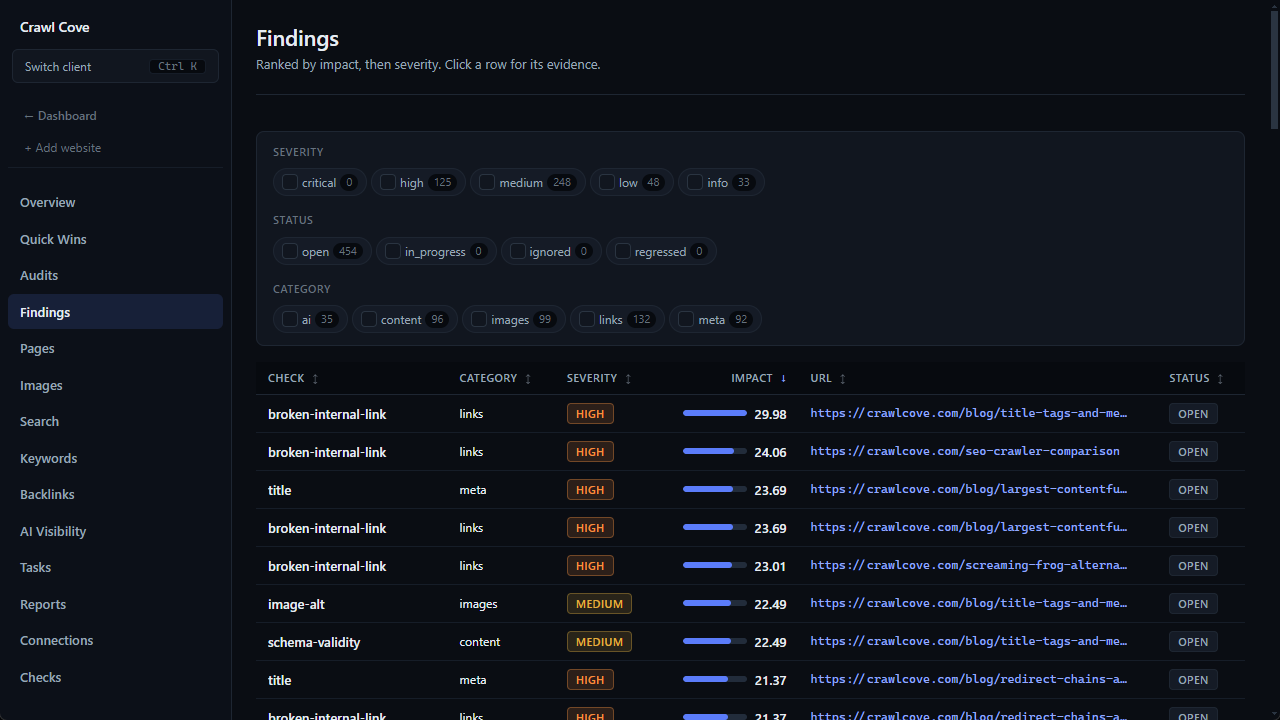
Every finding, ranked and explained
A single crawl feeds one table: filter by check, category or severity, and impact score keeps the highest-value fixes at the top instead of buried in a raw export.
The third option
Where Crawl Cove fits: the crawl and the fix.
Crawl Cove sits on the desktop side of this comparison, and it is aimed at the gap the other two leave: a crawler that does not stop at the finding. It runs locally on your own machine, crawls with no URL cap on any plan, and turns each issue into a plain-English, severity-ranked fix, with Google Search Console, Bing and Core Web Vitals on every plan (Search Console in one click, Bing and CrUX with a free key each), versioned audits so you can prove the fix landed, and native multi-client projects. Published pricing from £14.99/mo and a 14-day trial you start by downloading it, not by booking a call.
It is not an enterprise crawling platform and does not pretend to be one: no cloud scheduling, no shared team dashboards, no automated deployment QA. If you need those, Lumar is the category to shop in. If what you actually need is to audit a site properly and know what to do next, that is the whole design.
Frequently asked questions
- Is DeepCrawl still available?
- Not under that name. DeepCrawl rebranded to Lumar, and lumar.io still carries the "Deepcrawl is now Lumar" line in its own navigation for people arriving on the old name. The product did not disappear. It became the Lumar platform, which is organised as four applications (Analyze, Monitor, Protect and Impact) rather than the single crawler most people remember. So if you are comparing "DeepCrawl vs Screaming Frog", what you are really comparing is Lumar's enterprise platform against a desktop crawler.
- How much does Lumar (DeepCrawl) cost?
- Lumar does not publish a price. Its pricing page is a contact form ("simply fill out the form to get started") with no plan names and no figures, and no free tier or trial is mentioned on the platform pages either (checked September 2026). That is normal for sales-led enterprise software and it is not a criticism, but it is a real difference in how you buy: Screaming Frog is a £199-a-year licence you can put on a card this afternoon, and Lumar is a conversation with a salesperson first. If your budget approval process needs a number before a call, that matters.
- Which one should a small agency choose?
- If the honest scale of your work is client sites in the hundreds or low thousands of URLs, an enterprise crawling platform is the wrong shape of tool. You would be buying scale, governance and rollout that a two-person team never uses, through a procurement process built for enterprises. A desktop crawler covers that work. Screaming Frog is the established choice; Crawl Cove is the newer one, built around explaining the fix rather than exporting the finding. Lumar earns its keep at genuine enterprise scale, which is what it says it is built for.
- Can a desktop crawler handle a large site?
- Up to a point, and the limit is your machine rather than a licence. Screaming Frog removes its 500-URL free cap on the paid licence and then crawls as far as your RAM and disk allow; Crawl Cove has no URL cap on any plan. Where cloud platforms genuinely pull ahead is continuous scheduled crawling of very large sites, shared dashboards across a big team, and monitoring that runs whether or not anyone opened an app. If that describes your problem, you want a platform. If "audit this site properly, then show me what to fix" describes it, you want a crawler.
Related comparisons
-
Crawl Cove vs Lumar (DeepCrawl)
The alternative page → - Local crawler vs cloud suite →
- Two desktop crawlers →
- Every tool in one table →
Stop guessing.
Start fixing.
Crawl Cove runs on your machine, connects to your real ranking data, and tells you exactly what to fix first. No per-feature paywalls, no spreadsheets, no guesswork.
28 days risk-free · No card required