
Most agencies' "fix tracking" is a spreadsheet nobody trusts and a status that means nothing because no one re-checked the page. Crawl Cove's Tasks board fixes that with one idea: the board verifies its own work against the same deterministic check that created the finding. A card doesn't reach "done" because someone said so — it reaches it because the check passed again.
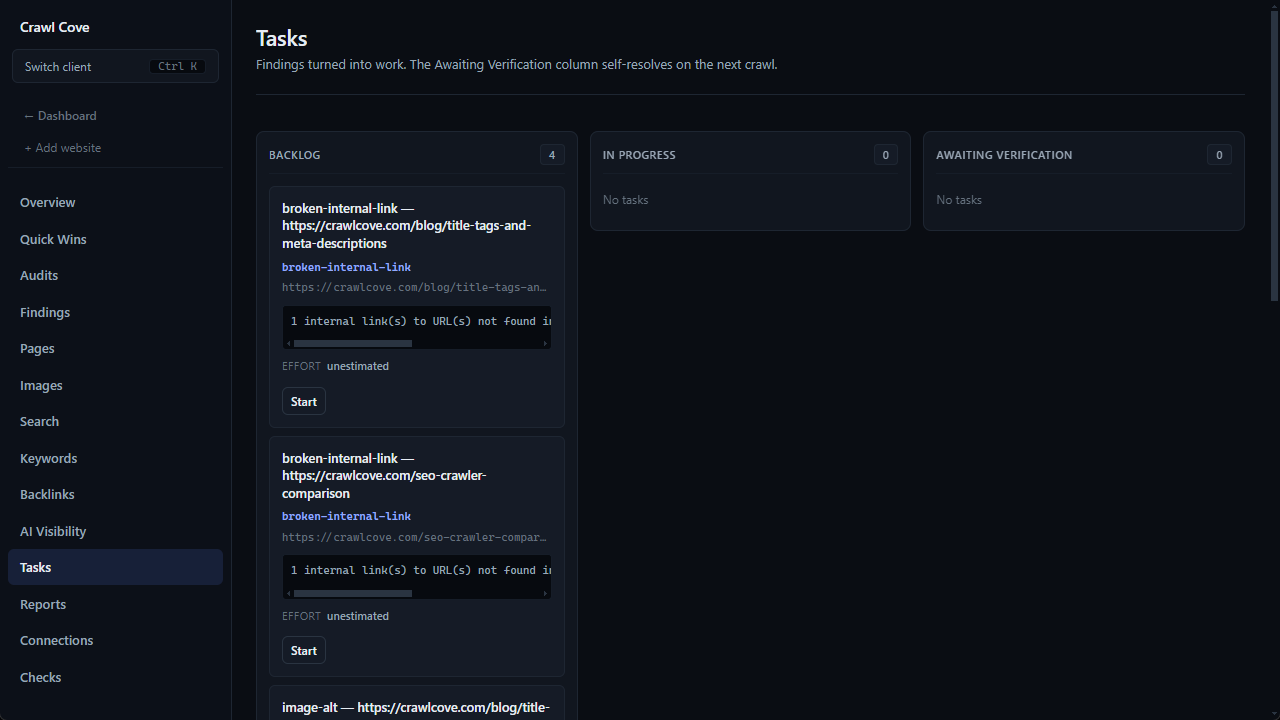
The client Kanban board
The client Tasks board has five columns:
Backlog → In Progress → Awaiting Verification → Needs Rework → Verified Fixed
Tasks are created straight from findings — the Create Task button in the evidence drawer pushes a finding onto the board carrying its finding link, evidence snippet, and effort estimate. So every card already knows exactly what's wrong, where, and roughly how long it'll take — no re-investigation. Cards drag between columns to change status, and drag within a column to reorder priority, which persists.
The self-resolving verification column — the trust engine
The Awaiting Verification column is where Crawl Cove stops being a tracker and becomes proof. It resolves two ways, and neither involves a human marking it "trust me, it's fixed":
- Passively, on the next crawl. When the next audit runs, it either confirms the finding is gone and moves the card to Verified Fixed, or it finds the issue back and bounces the card to In Progress as Regressed. Your normal monthly crawl quietly closes out the month's work.
- On demand, with the Verify button. Can't wait for the next crawl? Verify live re-fetches that one URL and re-runs the task's deterministic check — never the LLM. If the finding is gone, the card moves to Verified Fixed; if it's still present, it moves to Needs Rework. A site-wide check or a fetch failure degrades to honest copy rather than guessing.
The critical detail is never the LLM. Verification re-runs the exact coded check that raised the finding, so a "Verified Fixed" card means the same rule that flagged the problem now passes. That's a claim you can stand behind.
Tip
This is what you show a client to prove they're getting what they pay for. A white-label report drawn from the board says: here were 14 issues, here's the evidence, and here are the 11 now machine-verified as fixed — with a "wins this month" count that isn't your word, it's the check's. That converts a fuzzy retainer into demonstrable, recurring value.
All-clients Tasks (agency level)
At the agency level, the global Tasks page is a cross-client list/board — your actual week, not one client's. Group it by client, due date, or source-finding severity to see where capacity is going. You can quick-complete and reassign without entering a client workspace, and archived clients' tasks drop out of the global view automatically so the list stays focused on live work.
How it fits the workflow
The loop is tight: a deterministic check raises a finding → the evidence drawer turns it into a task with evidence and effort → you work it → Awaiting Verification confirms the fix (passively or on demand) → the win counts toward the report. Every step is evidence-backed and machine-checked, which is exactly the "prove the fix worked" story that wins renewals.
Next
- Proving the fix — delta chips and versioned audit history, the other half of the proof story.
- White-label reports — turn verified-fixed tasks into a branded report the client can see.